skip to main content
 How Much Office Space Do You Need for 10 Employees?

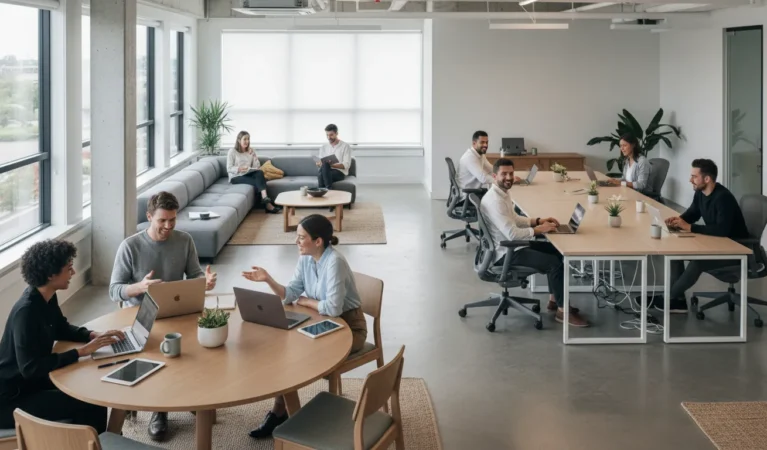
Table of Contents
- Introduction
- The Traditional Math vs. The Modern Reality
- Factors That Influence Your Space Requirements
- The Importance of Shared Amenities
- Operational Support: The Hidden Benefit of Flex Space
- Member Connection and Business Development
- Scalability: Planning for Employee Number 11 and Beyond
- Calculating the True Value of Your Space
- Designing the Ideal 10-Person Layout
- The Workbox Experience: Workspace with a Purpose
- Choosing Your Next Move
- Conclusion
- FAQ
Introduction
At what point does a growing team outgrow the kitchen table or the local coffee shop? For many founders and business leaders, that moment arrives when the headcount hits double digits. Reaching 10 employees is a significant milestone—it signals that your venture has moved past the initial “survival” phase and is now entering a period of scaling and operational complexity. However, this milestone brings a challenging question: how much office space do I need for 10 employees?
In the past, the answer was a simple mathematical formula based on square footage per desk. Today, the calculation is far more nuanced. It involves balancing the need for focused individual work with the necessity of collaborative zones, all while considering the financial implications of a long-term lease versus a flexible workspace. In this guide, we will break down the essential metrics of office space planning, explore how modern work habits change your footprint requirements, and explain why the “Member Success” model of workspace provides a more efficient and supportive environment than traditional real estate.
Our goal is to move beyond generic estimates and help you understand how to curate a workspace that fosters professional growth and operational ease. Whether you are a tech startup, a boutique consultancy, or a creative agency, finding the right amount of space is about more than just square footage—it is about providing your team with a platform for success.
The Traditional Math vs. The Modern Reality
Historically, commercial real estate brokers used a standard rule of thumb: 150 to 250 square feet per employee. For a team of 10, this would suggest a requirement of 1,500 to 2,500 square feet. This calculation was designed to account for individual desks, a small reception area, a breakroom, and perhaps one conference room.
However, these traditional figures often lead to “dead space” that companies pay for but rarely use. In a conventional office model, you are responsible for every square inch, including the hallways, the mechanical closets, and the lobby. When you scale that up for 10 people, you often find yourself paying for a significant amount of “usable” space that doesn’t actually contribute to your team’s productivity.
The Shift Toward Efficient Density
Modern office strategy favors a more dynamic use of space. Instead of giving every employee a massive cubicle, teams are moving toward “activity-based” layouts. In this model, the actual footprint of a private office can be smaller—perhaps 400 to 800 square feet for 10 desks—provided it is supplemented by high-quality communal areas.
At Workbox, we see this shift every day. Our private offices and suites are designed to maximize the “home base” for your team while leveraging our expansive common areas for everything else. This allows a 10-person company to occupy a more cost-effective private suite without feeling cramped, because the “office” extends far beyond the four walls of their specific room.
Factors That Influence Your Space Requirements
Before committing to a specific size, you must evaluate how your team actually works. No two 10-person companies are identical, and their spatial needs will reflect their specific industry and culture.
1. Hybrid Work and Attendance Patterns
Is your entire team in the office five days a week, or do you operate on a hybrid schedule? If only six or seven people are in the office at any given time, your physical desk requirement changes. However, even with a hybrid model, many leaders find that having a dedicated desk for every team member—rather than “hot-desking” within their own suite—creates a stronger sense of belonging and a more consistent routine.
2. The Need for Privacy vs. Collaboration
A team of 10 software engineers may require more “heads-down” space and phone booths for focus. Conversely, a marketing agency may need more “whiteboard space” and lounge seating for brainstorming. When calculating square footage, consider the ratio of individual workstations to collaborative furniture.
3. Client Interaction
Does your business require frequent in-person client meetings? If so, your workspace needs to project a professional image. A traditional office requires you to build, furnish, and maintain a high-end boardroom. In a flexible environment like Workbox, you have access to professional meeting rooms that start at $60/hr, allowing you to use (and pay for) premium client-facing space only when you need it.
The Importance of Shared Amenities
One of the biggest mistakes small companies make is forgetting to account for the “non-desk” space. In a traditional lease, the square footage you need for a 10-person team balloons once you add a kitchen, a lounge, a printing station, and a reception area.
Common Areas as a Force Multiplier
When you choose a workspace built around the Member Success philosophy, you gain access to an entire ecosystem of amenities that you don’t have to manage yourself. This includes:
- Kitchens and Cafés: Fully stocked with complimentary coffee, tea, and filtered water.
- Phone Booths: Essential for private calls without taking up a full meeting room or distracting the rest of the team.
- Wellness Rooms: Dedicated spaces for personal needs or a moment of respite.
- Lounges: Professional areas for casual meetings or a change of scenery from the desk.
By utilizing these shared spaces, the “private” square footage you need for your 10 employees can be much more focused on their primary work functions, effectively reducing your overhead while increasing the quality of the work environment.
Operational Support: The Hidden Benefit of Flex Space
Managing an office for 10 people is an administrative burden that often falls on the shoulders of the founder or a high-level manager. When you rent a traditional office, you aren’t just paying for space; you are becoming an office manager.
Reducing the Administrative Load
Consider the time and effort required to coordinate the following:
- Utilities and Internet: Setting up high-speed, secure Wi-Fi and Ethernet and managing monthly bills.
- Cleaning Services: Hiring and scheduling professional cleaning to keep the workspace presentable.
- Maintenance: Fixing a broken light fixture or a leaking sink.
- Supplies: Ordering everything from printer toner to kitchen snacks.
At Workbox, we provide a seamless bundled workplace environment. We take the day-to-day office administration off your plate so you can focus on growing your business. This bundled workplace environment simplifies your operations from day one, allowing you to avoid the complexity of multiple vendors and lease negotiations.
Professional Presence from the Start
For a team of 10, brand identity is crucial. We include company logo placement on your office door at no additional cost, ensuring that when clients or partners visit, they see your brand front and center. This professional touch, combined with a dedicated community manager to greet guests, gives a 10-person team the stature of a much larger organization.
Member Connection and Business Development
A workspace should be more than just a place to sit; it should be a place where your business can find its next partner, client, or investor. This is where the Workbox differentiator—Member Connection—becomes vital.
High-Quality Interactions
When a team of 10 is isolated in a traditional office, they lose the opportunity for “productive collisions” with other industry leaders. Our spaces are designed to facilitate network building. Through community-based engagements and quarterly mixers, your team becomes part of a powerful network of innovators and leaders.
The Business Development Layer
Scaling a 10-person team requires more than just square footage; it requires resources. Workbox members (at the Floating Membership level or higher) gain access to a virtual platform and business-development resources, including:
- Purposeful Programming: Networking events with capital partners, business leaders, and founders.
- Vendor Discounts: Access to cloud credits and discounts on essential business services that help reduce operating costs.
- Capital Access: While we never guarantee funding, our connectivity to investors and innovators provides a fertile ground for teams looking to raise capital or seek strategic advice.
For a leader of a 10-person company, these resources provide a “support layer” that a traditional landlord simply cannot offer.
Scalability: Planning for Employee Number 11 and Beyond
One of the most significant risks for a 10-person company is “over-committing” to space. In the traditional market, you might be forced into a 7-to-10-year lease for a space that is either too big now (wasting money) or will be too small in 18 months (stunting growth).
Flexible Terms for Dynamic Growth
Flexible workspace models allow you to scale your footprint as your team grows. If you hire two more people next quarter, moving from a 10-person suite to a 12-person or 15-person suite is a simple transition, not a legal nightmare. This reduces the upfront commitment and allows you to keep your capital focused on hiring and product development rather than security deposits and furniture costs.
“For a small team transitioning out of their initial scrappy phase, a private office provides the consistency and privacy needed for growth, while the surrounding community ensures they never feel isolated from the broader market.”
Calculating the True Value of Your Space
When asking “how much office space do I need for 10 employees,” it is important to look at the total value, not just the monthly rent.
The Low Upfront Cost
In a traditional office, you might be expected to provide six months of rent as a deposit, plus the cost of furnishing the space (estimated at $1,000 per office or desk) and setting up technology hardware.
In a Workbox environment, our private offices and suites start at $500/mo (varying by location and availability) and come already furnished with desks and chairs. The commitment is often as low as a two-month minimum, providing a level of financial agility that is impossible to find in the conventional commercial market.
Bundled Efficiency
By bundling internet, cleaning, utilities, and coffee into a single membership, you eliminate the hidden costs of running an office. This predictability in your monthly burn rate is essential for 10-person teams that need to manage their cash flow meticulously.
Designing the Ideal 10-Person Layout
If you are moving into a private suite at Workbox, you have several options for how to arrange your 10-person team to maximize productivity and comfort.
The “Pod” Configuration
Group desks into “pods” of 2 or 4. This encourages collaboration within specific departments (e.g., the dev team in one pod, the sales team in another) while keeping the center of the room open for movement.
The Hybrid Layout
Dedicate 8 desks for permanent use and keep a small lounge area or a “swing table” within your suite for the remaining 2 spots. This works perfectly for teams where some members are frequently out for client meetings or work remotely part-time.
The Executive Focus
Some 10-person teams prefer a large open area for 8 staff members and one or two smaller glass-partitioned offices within the suite for leadership. This provides the “open door” feel of a modern startup while allowing for confidential conversations when needed.
The Workbox Experience: Workspace with a Purpose
At Workbox, we believe that “Success Takes More” than just a desk and an internet connection. Our approach to workspace is centered on Member Success—a holistic combination of physical space, community connectivity, and an enabling layer of resources.
Nearly two-thirds of our member companies choose Workbox as their corporate headquarters. They do so because we provide more than just a room; we provide a destination for leaders and innovators. From the moment your team arrives, they have 24/7 access to their home-base location, secure Wi-Fi, and a dedicated community manager whose job is to ensure your day-to-day operations run smoothly.
Whether you are hosting a team brainstorm in one of our private conference rooms or connecting with a potential investor at a quarterly mixer, your workspace becomes an active participant in your company’s growth.
Choosing Your Next Move
Deciding how much space you need for 10 employees is a balance of current requirements and future aspirations. If you choose a space that is too small, you risk burnout and friction. If you choose a space that is too large and rigid, you risk financial strain.
The solution lies in flexibility. By choosing a workspace that offers a professional “home base” for your 10 employees while providing access to a national network of locations and a robust business development platform, you are setting your team up for long-term success.
Key Takeaways for 10-Person Teams:
- Don’t overpay for “dead space”: Focus on the quality of the private suite and the breadth of the shared amenities.
- Prioritize Operational Support: Offload the burden of office management so you can focus on your core business goals.
- Invest in Connection: Choose an environment where your team can interact with other professionals and innovators.
- Stay Flexible: Opt for membership terms that allow you to scale up as your headcount grows.
Conclusion
Determining how much office space you need for 10 employees is a pivotal decision for any growing organization. While traditional real estate would suggest a massive square footage requirement and a decade-long commitment, modern workplace strategy points toward a more efficient, flexible, and resource-rich approach. By focusing on a “Workspace with a Purpose,” you can provide your team with a professional headquarters that reduces administrative headaches and fosters meaningful professional connections.
At Workbox, we are dedicated to helping teams of all sizes find the perfect balance of private workspace and community-driven resources. Our suites are designed to reflect the professional standards of your brand, while our Business Development layer provides the tools you need to reach the next level of success.
Ready to find the ideal home for your team of 10? Explore our diverse range of locations and see how our Member Success philosophy can transform your workday. Schedule a tour today.
FAQ
How many square feet is typical for a 10-person private office in a flexible workspace?
In a flexible workspace like Workbox, a private office for 10 people typically ranges from 400 to 800 square feet. This is more efficient than a traditional office because it focuses on the “desk area,” while the kitchen, lounges, and meeting rooms are provided as shared amenities throughout the facility.
Can my 10-person team access other locations if we have a home-base office?
Yes. Members with a private office, suite, or desk membership have 24/7 access to their home-base location. Additionally, they have access to any other Workbox location nationwide during staffed hours, which are 8:30 am to 5:00 pm, Monday through Friday.
Does Workbox provide mailing and packaging services for 10-person companies?
Mailing and packaging services are available to all members holding a Floating Membership or higher, including those in private offices. This allows your business to maintain a professional address and receive packages securely. Specific details and availability may vary by location and membership type.
What is included in the operational support for a 10-person suite?
Workbox provides a bundled workplace environment that includes fast and secure Wi-Fi/Ethernet, professional cleaning services, a dedicated community manager, and utilities. We also include your company logo placement on your office door at no extra cost, helping you maintain a professional brand presence without the administrative burden of a traditional lease.