skip to main content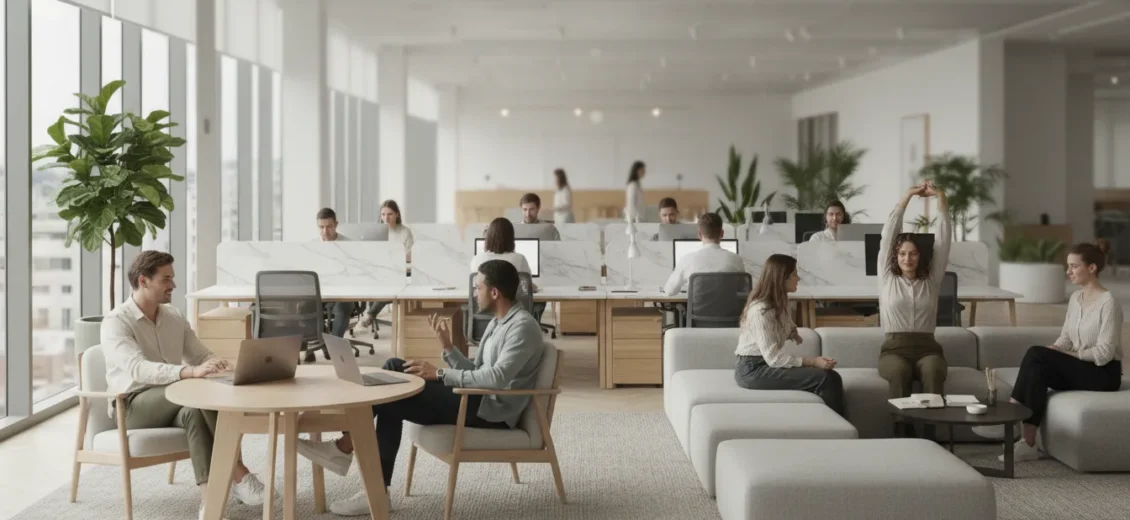
Table of Contents
- Introduction
- Defining the Standard: Calculating the Raw Numbers
- The Flexible Workspace Advantage: Space Efficiency
- Operational Support and the Hidden Burden of Traditional Space
- Layout Strategies for a Team of 12
- The Cost of Commitment: Traditional vs. Flexible
- Member Success: Beyond the Square Footage
- Transitioning Your Team: A Practical Scenario
- Scalability: Planning for the 13th, 14th, and 15th Employee
- The Importance of Professional Amenities
- Making the Decision: What Is Your Priority?
- Conclusion
- FAQ
Introduction
Imagine the moment your team finally hits that magic number: twelve. For many founders and business leaders, reaching a twelve-person headcount is a significant milestone. It often marks the transition from a scrappy, “all-hands-on-deck” startup to a structured organization with specialized roles and departmental needs. However, this growth spurt often brings a jarring realization: the workspace that felt cozy with six people is now cramped, loud, and hindering productivity. When you start searching for a new home for your team, the first question is inevitably: how much office space for 12 people do we actually need?
The answer is rarely a single number. Calculating square footage for a team of twelve involves balancing physical desk space with the less obvious requirements of a functional workplace—meeting rooms, break areas, and the “circulation space” that allows people to move without bumping into chairs. Furthermore, the modern workplace has shifted the math. The traditional requirement for massive, dedicated square footage is being replaced by a more efficient, flexible model that prioritizes member success and operational ease over raw real estate.
In this article, we will break down the essential metrics for determining the right amount of office space for a team of twelve. We will explore the differences between traditional leases and flexible workspace models, evaluate the hidden costs of managing your own square footage, and explain how a “workspace with a purpose” can help your team thrive without the administrative burden of a conventional office. Our goal is to provide a practical strategy that allows you to focus on your business goals while we handle the operational backbone of your workplace.
Defining the Standard: Calculating the Raw Numbers
When evaluating how much office space for 12 people is necessary, most commercial real estate experts point to a standard range. Historically, the rule of thumb was 200 to 250 square feet per person. For a team of 12, that would suggest a total of 2,400 to 3,000 square feet.
However, these numbers often reflect a traditional “corporate” layout with large individual offices and wide hallways. In the contemporary landscape, where collaboration and agility are prioritized, teams often find success with a more efficient “high-density” or “functional” layout. Under these modern standards, the breakdown often looks like this:
The Individual Workstation
Each team member needs a dedicated place to focus. In a modern office, a standard desk setup usually requires about 50 to 60 square feet per person. For 12 people, this accounts for roughly 600 to 720 square feet of “usable” desk area. This includes the desk itself, a chair, and a small amount of personal space behind the seat for movement.
Internal Meeting and Collaboration Areas
A team of 12 cannot function purely at their desks. They need spaces for syncs, brainstorming sessions, and private calls. In a traditional lease, you would need to build out at least one 10-12 person conference room (approx. 250-300 sqft) and a smaller huddle room or two (approx. 100-150 sqft each). This adds another 400 to 600 square feet to your requirement.
Circulation and Common Areas
You must account for the space between desks, the path to the door, and communal areas like a kitchenette or a reception zone. This “circulation space” typically accounts for 30% to 40% of your total square footage. For a team of 12, this adds significant overhead to a traditional floor plan.
When you add these components together in a traditional office setting, you are looking at a requirement of roughly 1,500 to 2,000 square feet. But here is the catch: in a traditional lease, you pay for every square foot of that “dead space” (hallways, lobbies, and kitchenettes) even when it is not being used.
The Flexible Workspace Advantage: Space Efficiency
The most significant shift in modern workplace strategy is the realization that you don’t need to own or lease every square foot your team uses. This is where the Workbox model changes the calculation of how much office space for 12 people you need to pay for.
In a flexible environment, the “shared infrastructure” significantly reduces your private footprint without sacrificing quality or functionality. When your team of 12 occupies a private office or suite at Workbox, your dedicated square footage focuses primarily on workstations and internal team dynamics. You don’t need to build a 12-person boardroom because you have access to professional, private conference rooms on-demand. You don’t need to dedicate 300 square feet to a kitchen because a fully stocked cafe and lounge are just outside your office door.
This model allows a team of 12 to operate comfortably in a smaller private footprint while enjoying the amenities of a space three times that size. This isn’t just about saving on rent; it’s about “Workspace with a Purpose.” By utilizing shared communal areas for your high-quality member-to-member interactions and using your private suite for focused work, you optimize both your budget and your team’s workflow.
Operational Support and the Hidden Burden of Traditional Space
When calculating space requirements, many leaders forget to factor in the “operational square footage”—the space required for the machinery of an office. In a traditional lease, you must account for:
- Server closets and IT infrastructure.
- Janitorial closets and supply storage.
- Printing and mailing stations.
- Reception areas for guests.
Beyond the physical space, there is the administrative burden. Managing a traditional office for 12 people requires coordinating with multiple vendors, which takes valuable time away from your core business. At Workbox, we provide a seamless operational backbone that helps members operate smoothly and reduces the administrative burden of running an office.
Consider the logistical requirements of a traditional 1,800-square-foot office. You would be responsible for sourcing and managing:
- Cleaning services: Professional cleaning must be scheduled and overseen. (Industry estimates for janitorial services are often around $3,800–$4,000/mo for a dedicated office).
- Utilities and Internet: You must negotiate contracts and ensure uptime. (High-speed dedicated internet for a team of 12 can be estimated at $200–$900/mo).
- Furniture and Setup: You have to purchase desks and chairs and coordinate the installation. (Furniture is typically estimated around $1k per office/workstation).
In a flexible model, these elements are bundled into your membership. This reduces the day-to-day office administration and simplifies operations from day one. Instead of managing a lease and four different utility providers, you have a dedicated community manager and a single monthly invoice. This allows your team to focus on Member Success rather than troubleshooting a printer or an internet outage.
Layout Strategies for a Team of 12
When deciding on a layout for your twelve-person team, the goal is to balance the need for focus with the necessity of collaboration. A well-designed 12-person suite should feel like a headquarters, not just a room full of desks.
The “Pod” Approach
For many teams, especially in tech or professional services, arranging desks in pods of four or six encourages natural communication. This layout leaves more open floor space, making the office feel larger and allowing for easier movement. At Workbox, our suites are designed to facilitate this kind of network building within your own team.
Privacy and Deep Work
Even in a team of 12, individuals need privacy for client calls or deep concentration. We provide access to phone booths and private meeting rooms, ensuring that a loud brainstorming session at one pod doesn’t derail a critical call at another. Using a quieter environment in a private space when needed is a key component of a healthy office routine.
Brand Identity and Culture
For a growing company, culture is everything. Nearly two-thirds of our member companies choose Workbox as their corporate headquarters because we provide the stability and professional presence they need. This includes the ability to have your company logo placed on your office door at no additional cost. It sounds like a small detail, but for a team of 12, walking past their own brand every morning builds a sense of belonging and permanence that a shared table in a coffee shop never could.
The Cost of Commitment: Traditional vs. Flexible
When companies ask how much office space for 12 people they need, they are also indirectly asking about the financial commitment. The traditional real estate market often requires a 7–10 year minimum lease. For a team of 12—which might be a team of 25 in two years—committing to a decade-long lease is a massive risk.
Furthermore, traditional leases often require significant upfront capital, including a security deposit that could equal 6 months of rent. In contrast, the flexible model typically involves a much lower upfront commitment, often around 1 month of rent with a 2-month minimum lease. This flexibility is vital for leaders and innovators who need to stay agile.
The practical value of a bundled workplace environment is most evident when you look at the total cost of occupancy. By avoiding or reducing common traditional-office burdens—such as lease negotiations (estimated at $2k–$10k), technology hardware (estimated at $5 per sqft), and ongoing utilities (estimated at $0.50–$1.50/mo per sqft)—a team of 12 can reallocate those funds into their own growth and development.
Member Success: Beyond the Square Footage
At Workbox, we believe that “Success Takes More” than just a desk and a chair. While the physical square footage is the foundation, the enabling layer of resources and support is what actually drives business growth. When you choose a workspace for 12 people, you aren’t just choosing a floor plan; you are choosing an ecosystem.
Member Connection and Community
A team of 12 can sometimes feel isolated if they are in a traditional standalone office. By being part of a larger community, your team gains access to high-quality member-to-member interactions. This includes weekly community-based engagements and quarterly mixers designed to facilitate connections. For a founder, these interactions might lead to a new partnership; for an employee, it provides a broader professional network and a more vibrant daily experience.
Business Development Resources
Our approach includes a Business Development layer that a traditional landlord simply doesn’t offer. Members have access to a virtual platform and business-development resources, including vendor discounts and cloud credits. For a mid-sized team, these operational savings and resources can significantly impact the bottom line.
Access to Capital and Leaders
For those in the innovation or investment sectors, being in a destination for leaders and investors is invaluable. While we offer no guarantees of funding, our purposeful programming and access to partnership events across the country support greater professional connection. This is particularly relevant for startups where the team of 12 is actively looking for its next round of growth capital.
Transitioning Your Team: A Practical Scenario
Let’s look at a practical scenario. Imagine a small professional services firm—perhaps an architectural or consulting group—that has been working remotely or in a very small “starter” office. They have just hired their 12th employee and realized that their current arrangement is no longer professional or productive.
If they choose a traditional office, they spend the next three months negotiating a lease, buying furniture, and setting up utilities. One of the partners effectively becomes the “office manager,” spending hours every week on admin tasks. The office feels empty because they had to lease 2,500 square feet to ensure they have a conference room and kitchen, but those spaces sit empty 80% of the time.
Now, imagine that same team moving into a Workbox private suite. On day one, they walk in and find a fully furnished, branded office. Their high-speed internet is already running. They have 24/7 access to their home-base location. When they have a big client presentation, they book a premium meeting room. When they need a break, they head to the cafe for complimentary coffee or tea and end up chatting with a founder from a different industry during a community breakfast.
For this team, the “space for 12 people” is more than just square footage—it is a platform for growth. They have reduced their administrative burden and joined a powerful network of other innovators and leaders.
Scalability: Planning for the 13th, 14th, and 15th Employee
One of the most difficult parts of calculating how much office space for 12 people you need is predicting when that number will change. In a traditional lease, you are locked into your square footage. If you grow to 15 people, you are suddenly overcrowded; if you shrink to 10, you are paying for empty desks.
Flexible workspace is built for this volatility. Because we offer everything from floating memberships to large private suites, we can accommodate your team as it evolves. Many of our members start with a small office and move into a larger suite as they scale, or they maintain a private office for their core team of 12 and use desk memberships for remote employees who visit the office occasionally.
This ability to scale without breaking a lease or moving across town is a cornerstone of our Member Success philosophy. We provide the space you need today with the flexibility to adapt for tomorrow.
The Importance of Professional Amenities
When you have a team of 12, the quality of your amenities becomes a tool for talent retention and recruitment. A cramped office with a tiny coffee pot doesn’t inspire the same level of commitment as a professional, well-appointed workspace.
Our members enjoy a curated menu of membership benefits designed to support a productive workday:
- Fast, secure Wi-Fi & Ethernet: Essential for high-stakes digital work.
- Private conference rooms: Professional environments for internal or client-facing meetings.
- Phone booths: Essential for privacy in an open-office environment.
- Mailing & packaging services: Available to members (Floating Membership or higher; details vary by location), ensuring your business operations are handled professionally.
- Wellness room: A space for members to take a moment for themselves.
- Filtered water, coffee, tea, and beer: Standard comforts that keep a team fueled and happy (beer available where applicable).
- Professional cleaning services: Ensuring a pristine environment without you having to lift a finger.
By bundling these amenities, we provide a premium experience that would be prohibitively expensive and time-consuming for a team of 12 to curate on their own.
Making the Decision: What Is Your Priority?
Ultimately, the question of how much office space for 12 people you need depends on your business priorities. If your priority is absolute control over every paint color and the ability to manage your own janitorial staff, a traditional lease might be your path.
However, if your priority is Member Success, Member Connection, and Operational Support, then a flexible workspace is the smarter strategic choice. By choosing a workspace that provides a “destination” for your team, you are investing in their productivity and your company’s future.
You are looking for a place where your team can collaborate effectively, where your operational overhead is minimized, and where you are surrounded by other leaders and innovators. That is the Workbox difference. We don’t just provide square footage; we provide a workspace with a purpose.
Conclusion
Calculating how much office space for 12 people is required is about more than just multiplying a headcount by a square footage metric. It is about understanding the flow of your workday, the necessity of professional amenities, and the value of your time. While traditional metrics might suggest a 2,000-square-foot requirement, the efficiency of a flexible workspace allows you to occupy a more focused private footprint while gaining access to a much larger ecosystem of support and community.
Choosing the right workspace is a pivotal decision for any team of twelve. It sets the tone for your company culture, determines your operational efficiency, and defines how you interact with the broader business community. By opting for a model that bundles space, technology, and business development resources, you free your team to do what they do best: innovate and grow.
At Workbox, we are committed to helping your team achieve its goals through our holistic approach to the workplace. From our high-quality suites and 24/7 access for members to our weekly engagements and professional community managers, we provide everything a team of 12 needs to succeed.
Are you ready to find the perfect home for your team of twelve? We invite you to explore our locations and see how our tailored workspace solutions can support your growth. Schedule a tour to learn more about our membership options.
FAQ
How many square feet do I really need for a team of 12?
While traditional commercial real estate suggests 2,400–3,000 square feet for 12 people, a flexible workspace allows you to be much more efficient. In a Workbox private suite, you can comfortably house 12 people in roughly 1,000–1,500 square feet of dedicated space because you have access to thousands of square feet of shared amenities, such as conference rooms, cafes, and lounges.
What are the main benefits of flexible workspace for a team of 12 vs. a traditional lease?
The primary benefits include a significantly lower upfront commitment (usually 1 month’s rent vs. 6 months), faster move-in times, and the elimination of administrative burdens. At Workbox, we handle the internet, cleaning, utilities, and furniture, allowing you to focus on your core business. Additionally, you gain access to our Business Development layer and community networking opportunities that a traditional landlord does not provide.
Can our team of 12 have a private, branded space in a coworking environment?
Yes. At Workbox, we provide private offices and suites specifically designed for teams of this size. These are fully enclosed spaces that serve as your dedicated headquarters. Furthermore, company logo placement on your office door is included at no additional cost, helping you maintain your brand identity within our professional community.
What kind of access will my team have to the office?
For teams with Private Office or Suite memberships, all members have 24/7 access to their home-base location. Additionally, they have access to any other Workbox location nationwide during staffed hours, which are 8:30 am to 5:00 pm, Monday through Friday. This provides your team with the flexibility to work whenever and wherever they need to be.