skip to main content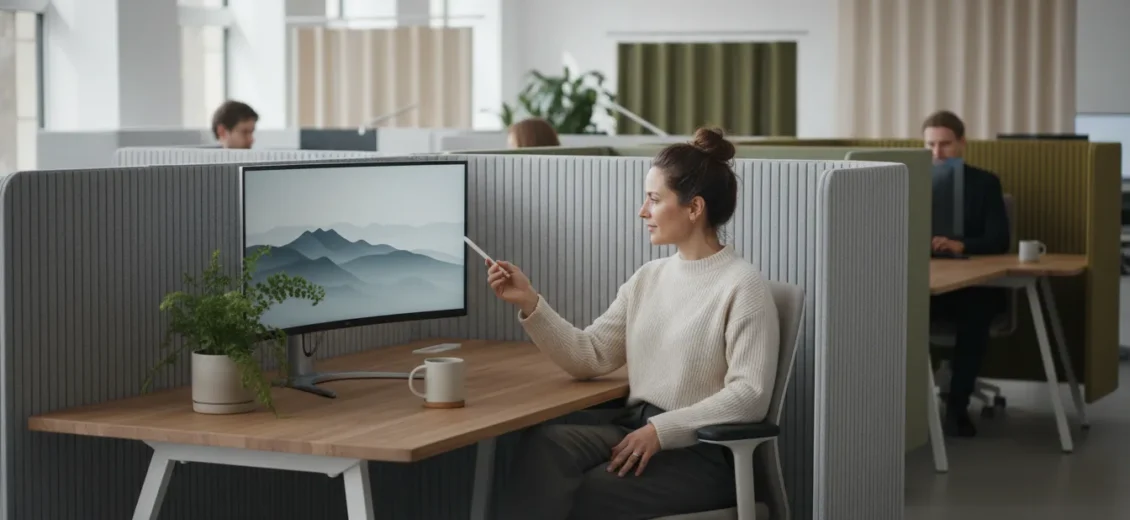
Table of Contents
- Introduction
- The Evolution of the Open Office and the Need for Privacy
- Physical Strategies for Increasing Privacy
- Cultural and Behavioral Approaches to Privacy
- The Workbox Approach: Workspace with a Purpose
- Strategic Workspace Choices for Maximum Privacy
- Designing Your Workday for Privacy
- The Business Development Layer: Privacy as a Strategy
- Beyond the Walls: The Practical Value of Flex Space
- Practical Scenarios: Privacy in Action
- Conclusion
- FAQ
Introduction
Have you ever sat at your desk, trying to finalize a high-stakes proposal, only to realize you can perfectly narrate the lunch plans of a colleague three rows over? The open office was originally designed to break down silos and spark spontaneous collaboration, but for many professionals, it has become a “goldfish bowl” where privacy feels like a luxury of the past. When your work requires deep focus or your conversations involve sensitive client data, the lack of boundaries isn’t just a minor annoyance—it is a barrier to your professional success.
The purpose of this guide is to explore practical, actionable strategies for how to make open office space more private without sacrificing the community and connectivity that make shared environments so valuable. We will delve into physical modifications, cultural shifts, and strategic workspace choices that empower you to take control of your environment. At Workbox, our philosophy is centered on “Workspace with a Purpose,” and we believe that Member Success is only possible when professionals have the right tools to balance collaborative energy with the privacy required for high-level execution.
True privacy in a modern workplace is not just about four walls and a door; it is about creating a customized workflow that integrates physical space, operational support, and intentional community norms to protect your time and focus.
The Evolution of the Open Office and the Need for Privacy
The open office layout became the industry standard because it promised transparency and easy access to teammates. While these benefits are real, the unintended consequence was the erosion of “focus time.” Research consistently shows that even minor auditory or visual distractions can derail cognitive flow, taking significant time to recover once interrupted.
For the modern founder or consultant, privacy is a functional requirement. Whether you are discussing a confidential term sheet, conducting a performance review, or simply needing to “go dark” to hit a deadline, the ability to find a quieter environment in a private space is essential. We view the workspace as a tool for growth, and like any tool, it must be versatile enough to accommodate different modes of work.
The Cost of Distraction
When we talk about the need for privacy, we are really talking about the protection of human capital. Every time a professional is forced to overhear a phone call that doesn’t concern them, or feels “watched” in a way that prevents them from entering a state of flow, productivity dips. In a traditional office setting, solving this often requires expensive renovations or long-term lease commitments that smaller teams simply cannot justify.
In a flexible environment, however, privacy is managed through a blend of design and membership options. By understanding how to navigate these spaces, you can reclaim your focus without the overhead of a conventional lease.
Physical Strategies for Increasing Privacy
If you are working in a shared or open environment, the first step is to maximize the physical tools available to you. You do not need to build permanent walls to create a sense of seclusion.
Utilizing Phone Booths for Confidential Conversations
One of the most effective ways to make an open office feel more private is to remove loud, sensitive, or distracting conversations from the common area entirely. At Workbox, we provide phone booths specifically for this purpose. These are enclosed, sound-insulated spaces designed for short-term use.
For a consultant who spends half their day on discovery calls, the phone booth is a game-changer. Instead of worrying about who might be listening or whether they are bothering their neighbors, they can step into a booth for a private, professional environment. This simple movement creates a physical boundary that signals to the rest of the community that they are “unavailable,” while also keeping the open area quieter for everyone else.
Leveraging Private Meeting Rooms for Focused Group Work
Privacy isn’t always an individual need. Small teams often need a space where they can whiteboard a strategy or discuss internal financials without broadcasting their plans to the entire floor. Private meeting rooms serve as the “war rooms” of the modern office.
Booking a meeting room (at Workbox, these start at $60/hr for non-members or are included in various membership tiers) allows a team to transition from the social energy of the common area to a high-focus environment. This “room-hopping” strategy is a core part of making an open office work. You use the open space for light tasks and community connectivity, and you reserve the meeting rooms for the moments that demand confidentiality and intense collaboration.
Visual and Physical Cues
In the absence of walls, visual cues become the new boundaries. This can be as simple as the direction your chair faces. If your desk allows for it, positioning yourself so your back is to a high-traffic hallway can reduce visual distractions.
Furthermore, many of our members use “digital boundaries.” When you see a colleague with large headphones on, it is a universal signal in the coworking world that they are in a state of deep work. Respecting these cues is a foundational part of our community connectivity. It allows individuals to remain in the heart of the action while maintaining a “bubble” of privacy.
Cultural and Behavioral Approaches to Privacy
While furniture and booths are important, the most private offices are those where the community has a shared understanding of professional etiquette.
Establishing Communication Norms
For a small team transitioning out of coffee shops or a home office, setting internal norms is the first step toward success. You might decide that 9:00 AM to 11:00 AM is “heads-down time,” where internal communication happens via Slack rather than across the desk.
By mirroring the “Workspace with a Purpose” mindset, teams can operate more efficiently. When everyone understands the schedule, the “openness” of the space becomes an asset for the afternoon’s brainstorming sessions rather than a liability for the morning’s deep work.
The Role of the Community Manager
At Workbox, our dedicated community managers play a vital role in maintaining the balance between a vibrant community and a productive workspace. They help facilitate an environment where high-quality member-to-member interactions occur during scheduled times—like our weekly community-based engagements or quarterly mixers—so that the rest of the time can be focused on business operations.
When the community manager sets the tone for the space, it reduces the administrative burden on you. You don’t have to be the “enforcer” of office etiquette; the culture of the space naturally encourages professional behavior and mutual respect for privacy.
The Workbox Approach: Workspace with a Purpose
We believe that a workspace should do more than just provide a desk; it should be a platform for Member Success. This means intentionally designing our locations to offer a spectrum of privacy levels.
Member Connection vs. Isolation
There is a common misconception that privacy means being alone. At Workbox, we view privacy as a tool for “recharging” so that you can better engage with the community when you’re ready. Our spaces are designed to facilitate network building and professional connection, but we recognize that connection is only valuable if you also have the space to actually do the work your connections bring in.
Nearly two-thirds of our member companies choose Workbox as their corporate headquarters because we provide that holistic balance. They get the high-energy environment of an innovation hub, but they also get the operational support and privacy of a traditional office.
Operational Support and Reduced Administrative Burden
Part of what makes an open office feel “exposed” or “unprofessional” is when the basic infrastructure fails—slow Wi-Fi, a printer that won’t connect, or a messy common area. These distractions are a form of privacy intrusion because they force you out of your work and into “office management” mode.
We provide a seamless operational backbone. This includes:
- Fast, secure Wi-Fi and Ethernet.
- Professional cleaning services.
- Unlimited printing.
- Mailing and packaging services for members (Floating Membership or higher).
By handling these details, we reduce the day-to-day office administration for our members. This is what we call “Operational Support.” It allows you to stay in your “private bubble” of focus because you aren’t being interrupted by the mundane tasks of running a physical office.
Strategic Workspace Choices for Maximum Privacy
If you find that physical cues and phone booths aren’t enough, it might be time to evaluate your membership type. Making an open office space more private often involves moving along the spectrum of workspace options we offer.
Private Offices and Suites
For many growing companies, the ultimate solution for privacy is a private office or suite. Starting at $500/month (varying by location and availability), these spaces provide a lockable door and a dedicated environment for your team.
A unique benefit we offer is that company logo placement on the office door is included at no additional cost. This reinforces your brand identity and creates a clear boundary between your “company culture” and the “community culture” of the broader Workbox location.
For a small team, a private office provides consistency and a home base. They can have their private internal conversations, leave their equipment securely overnight, and still step out into the common area for a coffee or to attend a networking event with capital partners and other founders.
Desk Memberships and Floating Memberships
If a full office isn’t required, a dedicated desk membership (starting at $350/month) offers a middle ground. While the space is still “open,” having a consistent spot allows you to set up your environment to your liking. You can add small desk partitions or simply benefit from the fact that your neighbors become familiar with your work style.
Floating memberships (starting at $250/month) offer the most flexibility. This is often the choice for the “mobile professional” who might use the open area at their home-base location for a few hours and then utilize 8:30 AM–5:00 PM access to another Workbox location nationwide when traveling for client meetings.
Designing Your Workday for Privacy
How you schedule your day can be just as impactful as where you sit. Privacy is often a function of time as much as it is of space.
The “Pulse” of the Workspace
Every coworking space has a natural rhythm. There are times when the common area is buzzing with energy—usually around mid-morning or during community breakfasts—and times when it is naturally quieter.
For a founder who needs to deep-dive into product development, learning the “pulse” of their Workbox location allows them to plan their most intense work for the quieter hours. Because members (including floating, desk, and office members) have 24/7 access to their home-base location, many choose to come in early or stay late to take advantage of the absolute privacy that comes with off-peak hours.
Purposeful Programming and Networking
We offer purposeful programming and access to partnership events that support professional connection. By attending these events, you can satisfy your need for community in a concentrated, high-value window. This allows you to be “fully present” for networking when the time is right, and “fully private” when it’s time to execute on your business goals.
The Business Development Layer: Privacy as a Strategy
In our ecosystem, we often talk about the “Business Development” layer. This is the idea that your workspace should actively help you grow. Privacy plays a massive role in this.
Protecting Your Intellectual Property and Strategy
When you are working on something innovative—perhaps something that might eventually interest the network of investors and leaders associated with Workbox—privacy is a matter of business security. You need to be able to work on your “stealth mode” projects without prying eyes.
Our private suites and offices provide the physical security needed for this, while our virtual platform and business-development resources provide the connectivity needed when you are ready to “go public” with your progress. This is the essence of “Workspace with a Purpose.” We give you the shell to protect your ideas and the bridge to help them cross over to the market.
Professional Presence for Client Meetings
Privacy is also about the experience you provide to your clients. Inviting a major partner to a noisy coffee shop or a cluttered home office doesn’t convey the same level of success as meeting in a professional, private conference room.
By using Workbox’s meeting rooms, you are leveraging our operational backbone to enhance your own professional presence. You get a clean, well-appointed space with fast Wi-Fi and filtered water, ensuring that your client’s focus remains entirely on your presentation and not on the background noise of an open office.
Beyond the Walls: The Practical Value of Flex Space
When people ask how to make open office space more private, they are often comparing their current situation to the “dream” of a traditional private office. However, it’s important to consider the practical trade-offs.
Traditional Office vs. Flexible Privacy
A traditional office lease often requires a 7–10 year minimum commitment and significant upfront costs for things like furniture, tech hardware, and lease negotiations. Furthermore, you become responsible for every operational detail—internet setup, janitorial services, and stocking the kitchen.
In contrast, Workbox offers a bundled workplace environment. We handle the “administrative burden,” and our commitment levels are far more flexible (often starting with a much shorter minimum lease than traditional models). This means you get the privacy of a professional office without the “operational debt” that usually comes with it.
For a consultant or a growing startup, the ability to scale your privacy as you grow—moving from a floating membership to a dedicated desk, and eventually to a private suite—is a much smarter business strategy than over-committing to a traditional lease too early.
Practical Scenarios: Privacy in Action
To understand how these strategies work in the real world, let’s look at a few common professional paths within our community.
The Independent Consultant
Imagine a marketing consultant who balances deep creative work with high-level client strategy sessions. They use a Desk Membership to have a consistent “home base.” On days when they need to build a complex campaign, they arrive early to utilize the quiet of the morning. When a client call is scheduled, they jump into a phone booth for 30 minutes of uninterrupted, confidential talk. If a potential new client wants a formal pitch, they book a private meeting room for an hour. This professional uses the variety of spaces within the Workbox ecosystem to “manufacture” privacy exactly when it’s needed.
The Growing Tech Team
Consider a five-person engineering team. They recently moved out of a cramped home garage and into a Workbox private office. While they love the community breakfasts and the chance to meet other founders at quarterly mixers, their day-to-day work requires intense collaboration and “whiteboarding.” Their private office allows them to keep their proprietary code away from public view, while the “Success Takes More” philosophy of Workbox ensures they have access to the business development resources they need to scale. For them, privacy is the foundation of their team culture.
Conclusion
Making an open office space more private is not an impossible task; it is an exercise in intentionality. By utilizing physical tools like phone booths and meeting rooms, establishing clear cultural norms, and choosing the right membership tier, you can create a workspace that supports both your need for focus and your desire for community.
At Workbox, we are committed to providing more than just four walls. Our “Member Success” philosophy means we are constantly looking for ways to improve your workday—whether that’s through our seamless operational support, our powerful network of leaders and innovators, or our diverse range of workspace options designed for every stage of business growth.
Privacy is ultimately about having the agency to choose how you work. Whether you are a solo founder or a team of fifty, you deserve a workspace that respects your focus and empowers your professional journey.
If you’re ready to see how a purposeful workspace can transform your productivity, we invite you to explore our locations across the country. From private suites with your company logo on the door to floating memberships that keep you mobile, we have the space you need to succeed.
Explore Workbox Locations and Find Your Perfect Workspace Today.
FAQ
How can I get privacy for a phone call if I don’t have a private office?
We provide sound-insulated phone booths at all of our locations for this exact reason. They are available to all members on a first-come, first-served basis and are perfect for short-term confidential calls or video meetings where you don’t want to be distracted or distract others.
Are meeting rooms included in my membership?
Meeting room access depends on your specific membership tier. Private office members and desk members typically have credits included, while others can book rooms at a competitive hourly rate (starting at $60/hr). All bookings are handled through our member platform, making it easy to secure a private space whenever you need it. For details about hosting or reserving meeting and event space, see our meeting and event spaces page: Meeting and event spaces.
Can I access other Workbox locations if I need a private place to work while traveling?
Yes. While floating, desk, and office members have 24/7 access to their home-base location, they also have access to other Workbox locations nationwide during staffed hours, which are 8:30 AM to 5:00 PM, Monday through Friday. This is perfect for maintaining a professional routine while on the road.
What is the best membership option for a team that needs maximum privacy?
A Private Office or Suite is the best option for teams that require a dedicated, lockable space. These start at $500/month and include your company logo on the door. It provides the perfect balance of a private “home base” for your team while still allowing you to tap into the broader Workbox community and business development resources.