skip to main content
 How Your Office Space Impacts Employee Well-being

Table of Contents
- Introduction
- The Psychology of Physical Environment
- Member Connection: The Antidote to Professional Isolation
- The Operational Backbone: Reducing Administrative Stress
- Designing for Focus and Privacy
- Professional Growth and the Business Development Layer
- Routine and the Importance of a Destination
- Practical Scenarios: Well-being in Action
- The Workbox Difference: Workspace with a Purpose
- Conclusion
- FAQ
Introduction
Think about the last time you spent eight hours working in a space with flickering fluorescent lights, a cramped desk, and the constant hum of a struggling HVAC system. By the time you packed up to leave, did you feel energized and accomplished, or were you reaching for the nearest caffeine fix just to make it through the commute? The environment in which we work is far more than a simple backdrop for our daily tasks; it is a fundamental pillar of our mental and physical health. Many professionals realize that where they work is just as important as the work they do, but understanding exactly how your office space impacts employee well-being is the key to creating a sustainable, high-performing career.
In this article, we will explore the multifaceted relationship between physical workspace and professional wellness. We will move beyond the surface-level discussion of “perks” and dive into the psychological impacts of social connectivity, the cognitive relief provided by operational support, and the importance of a workspace designed for Member Success. From the way natural light influences circadian rhythms to how a supportive community can mitigate the isolation of modern professional life, we will examine why the right office environment is a strategic investment in a team’s greatest asset: its people. Ultimately, we will demonstrate that when a workspace is treated as a platform for growth and connection rather than a mere utility, it becomes a catalyst for long-term health and success.
The Psychology of Physical Environment
The physical layout of an office acts as a silent language, telling employees how to feel and interact throughout the day. When we consider how your office space impacts employee well-being, the most immediate factors are often the most overlooked. Humans have an innate biological need for certain environmental cues to maintain focus and mood stability.
Natural Light and Circadian Rhythms
One of the most powerful environmental factors is access to natural light. Studies consistently show that professionals working in environments with ample window access and natural light report better sleep quality, lower stress levels, and higher energy during the day. This is because light regulates our circadian rhythm—the internal clock that tells our bodies when to be alert and when to rest.
At Workbox, we prioritize spaces that maximize light and offer views that connect members with the outside world. For a founder spending long hours on a new product launch, the difference between a windowless room and a bright, airy suite isn’t just aesthetic; it’s the difference between burnout and sustained focus.
Spatial Variety and Cognitive Load
A rigid office environment often forces a “one-size-fits-all” approach to work. However, the human brain functions best when it can move between different modes of thinking. Deep focus requires a different environment than collaborative brainstorming or a confidential client call. When an employee is forced to perform all these tasks at a single desk in an open area, their cognitive load increases as they struggle to tune out distractions or find privacy.
Providing a variety of space types—such as private offices, phone booths for confidential calls, and professional meeting rooms—allows individuals to choose the environment that fits their immediate needs. This autonomy is a major contributor to well-being, as it empowers professionals to take control of their workday rather than being at the mercy of their surroundings.
Member Connection: The Antidote to Professional Isolation
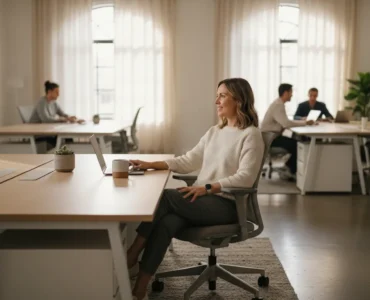
While the physical walls of an office are important, the people within those walls define the experience. In an era where remote and hybrid work have become common, many professionals suffer from a lack of high-quality member-to-member interactions. Isolation is a significant threat to well-being, often leading to decreased motivation and a sense of detachment from one’s professional identity.
Building a Community of Peers
Well-being is deeply tied to the feeling of belonging to a community of like-minded individuals. At Workbox, our philosophy is centered on “Workspace with a Purpose,” which means we intentionally design environments where leaders, innovators, and investors can connect. This isn’t about forced socialization; it’s about creating a destination where organic networking happens naturally.
Consider a small team transitioning out of coffee shops or a home garage. In those isolated settings, they may lack the professional presence and social stimulation needed to stay sharp. By moving into a private office within a larger ecosystem, they gain a home base while staying connected to a broader professional community. They can step out of their office and engage in a quarterly mixer or a community breakfast, gaining fresh perspectives that help them solve business challenges.
Purposeful Programming and Networking
Employee well-being is also influenced by a sense of professional progress. When professionals feel they are growing and connecting with the right people, their job satisfaction increases. High-quality programming—such as networking events with capital partners, business leaders, and founders—provides members with the resources they need to scale.
By offering access to a powerful network of other innovators, a workspace becomes more than a desk; it becomes a business development layer. This connectivity reduces the stress of “going it alone” and provides a support system that is vital for long-term mental health in high-stakes industries.
The Operational Backbone: Reducing Administrative Stress
A major, yet frequently ignored, factor in how your office space impacts employee well-being is the administrative burden of managing a workplace. For many business owners and managers, the “hidden” tasks of running an office are a constant source of low-grade stress.
Eliminating the “Office Manager” Tax
In a traditional office setting, someone has to be responsible for coordinating internet setup, managing utilities, hiring professional cleaning services, and ensuring the printer actually has ink. For a startup or a small firm, these tasks often fall on the shoulders of the leadership team, taking them away from their core mission and adding to their mental load.
A flexible workspace with a seamless operational backbone removes these burdens from day one. When you walk into a Workbox location, the essentials are already handled:
- Fast, secure Wi-Fi and Ethernet are ready to go.
- Professional cleaning services keep the environment pristine.
- Unlimited printing is available without the hassle of maintenance.
- Mailing and packaging services are managed for members (Floating Membership and higher), ensuring important documents are handled with care.
By bundling these workplace essentials, we allow our members to focus entirely on their success. The reduction in daily “operational friction” translates directly to a more relaxed and productive workforce.
Lowering Commitment Anxiety
Financial stress is a significant component of overall well-being. Traditional office leases often require 7-to-10-year commitments and massive upfront costs for furnishing and technology. This level of risk can be a heavy weight for a growing company to carry.
Flexible workspace models offer a practical alternative with lower upfront commitments and the ability to scale as the team grows. This flexibility provides a safety net, allowing businesses to adapt to changing market conditions without being trapped in a rigid, expensive contract. Knowing that your workspace can evolve with your needs provides a level of peace of mind that a traditional lease simply cannot match.
Designing for Focus and Privacy
A common concern in modern workplace strategy is the balance between community and privacy. To support well-being, a workspace must offer a quieter environment in a private space when the task demands it. Over-stimulation is a leading cause of workplace fatigue, making the availability of private zones essential.
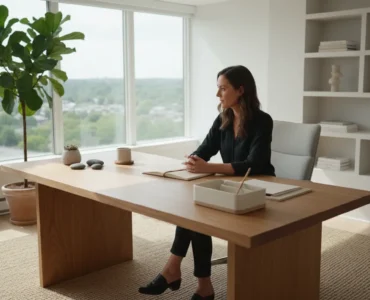
Private Offices and Suites
For many companies, a private office or suite serves as the ultimate anchor for well-being. It provides a dedicated “home base” where a team can build its own culture while still having access to the shared amenities of the wider community. At Workbox, we even include company logo placement on the office door at no additional cost, which helps foster a sense of pride and professional identity. Learn more about our private office and suite options on our workspace memberships & pricing page.
Phone Booths and Wellness Rooms
Not every task requires a full office, but many tasks require privacy. Phone booths are a critical feature for professionals who need to jump on a quick call without disturbing their neighbors or worrying about being overheard. Similarly, a wellness room provides a necessary space for members to take a moment for themselves, whether for medical needs, nursing, or a brief mental reset. These features acknowledge that employees are human beings with needs that extend beyond a computer screen.
Professional Growth and the Business Development Layer
Well-being isn’t just about the absence of stress; it’s about the presence of opportunity. When a workspace is aligned with a professional’s growth goals, it creates a positive feedback loop that enhances motivation and job satisfaction.
Access to Resources and Support
At Workbox, we believe “Success Takes More” than just a desk. Our Member Success model includes a Business Development layer that provides practical resources to help companies thrive. This includes:
- Access to a virtual platform and business-development resources.
- Vendor discounts and cloud credits that reduce overhead.
- Introductions to potential partners and investors through purposeful programming.
For a founder or a high-level executive, knowing that their workspace provider is actively looking for ways to support their business development can alleviate the feeling of being overwhelmed. This enabling layer of resources acts as a force multiplier for their efforts.
The Impact of a Professional Environment on Client Relations
Employee well-being is also tied to the confidence they feel when representing their company. Hosting a client in a high-quality, professional meeting room with complimentary coffee and tea—and perhaps a draft beer for a late-afternoon wrap-up—creates a much better experience than meeting in a loud, crowded public space. When employees feel proud of their office, their confidence increases, which in turn improves their performance and overall job satisfaction. Consider our meeting and event spaces when planning important client visits or presentations: Host an event.
Routine and the Importance of a Destination
In the wake of the shift toward remote work, many have discovered that working from home indefinitely can lead to a blurring of boundaries. Without a physical destination to go to, the “workday” never truly starts or ends, leading to a state of perpetual semi-work that is exhausting.
Creating Healthy Boundaries
An office space provides a physical and mental boundary between “work life” and “home life.” Having a professional destination to commute to helps establish a routine that signals to the brain when it’s time to be productive and when it’s time to disconnect.
For members with Floating or Desk memberships, having 24/7 access to their home-base location means they have the flexibility to work whenever they are most productive, while still maintaining that essential separation from their living space. Additionally, the ability to access any other Workbox location nationwide during staffed hours (8:30 am–5:00 pm) ensures that travel doesn’t have to disrupt this sense of routine.
The Role of the Dedicated Community Manager
At each of our locations, a dedicated community manager serves as the point of contact for our members. This isn’t just a receptionist role; it’s a role designed to facilitate connection and ensure the operational backbone of the office is running smoothly. Having a friendly, professional face to greet you each morning contributes to a positive office culture and ensures that any issues are resolved quickly, further reducing the stress on our members.
Practical Scenarios: Well-being in Action
To understand how these elements come together, let’s look at how different professionals might experience the impact of their workspace on their well-being.
The Consultant Balancing Variety and Focus
Consider a consultant who spends half their time on deep-dive strategy and the other half in back-to-back client meetings. In a home office, the isolation can start to feel oppressive, and the lack of a professional meeting space makes client interactions feel less formal.
By utilizing a Desk Membership, they gain a consistent place to work alongside other professionals. When they need to record a podcast or have a confidential call, they hop into a phone booth. When they have a high-stakes client presentation, they reserve a professional meeting room. This variety prevents the “stagnation” of working in the same four walls and provides the professional infrastructure that reinforces their brand. The presence of other innovators provides a “passive” networking environment where a casual conversation by the coffee machine might lead to their next big contract.
The Small Team Scaling with Confidence
Imagine a five-person tech startup that has just secured its first round of funding. They need to hire more people and build a cohesive company culture. If they were to sign a traditional five-year lease, the pressure of filling that space and the administrative headache of setting up the office could distract them from their product development.
Instead, they move into a private office at Workbox. Their logo is on the door, giving them an immediate sense of legitimacy. The “Success Takes More” philosophy means they can lean on the Workbox network for business development opportunities, and they can attend community events to meet potential hires or investors. Their team is happier because they are in a vibrant, light-filled environment with perks like filtered water, coffee, and community breakfasts. The leadership is less stressed because they aren’t worried about the internet going down or the trash being emptied—it’s all part of the bundled service.
The Workbox Difference: Workspace with a Purpose
When we talk about how your office space impacts employee well-being, we are really talking about the difference between a landlord and a partner. A traditional landlord provides four walls and a roof; a partner like Workbox provides an ecosystem designed for Member Success.
Nearly two-thirds of our member companies choose us as their corporate headquarters because we understand that space is only one part of the equation. By combining high-quality physical environments with a layer of operational support and a focus on member connection, we create a workplace that actually gives back to the people who use it.
Our spaces are designed to facilitate network building, whether through the physical layout of our common areas or our purposeful programming. We recognize that the leaders and innovators who choose Workbox are looking for more than just a place to sit; they are looking for a destination that supports their professional journey and their personal well-being.
Conclusion
The evidence is clear: the environment in which you work has a profound impact on your mental health, your productivity, and your professional fulfillment. From the biological benefits of natural light to the psychological necessity of social connection and the practical relief of operational support, every aspect of your office space plays a role in your overall well-being.
In a world where the lines between work and life are increasingly blurred, choosing a workspace that prioritizes Member Success is one of the most important decisions a professional or a team can make. By moving away from the “hidden taxes” of traditional office management and into a community-driven, operationally seamless environment, you can protect your team from burnout and position them for long-term growth.
At Workbox, we are committed to providing “Workspace with a Purpose.” We invite you to discover how a workplace designed for connection and support can transform the way you and your team feel about your work.
Ready to elevate your workday? Explore our diverse range of private offices, suites, and flexible memberships designed to support your success. View our locations and reach out today to schedule a tour and see the Workbox difference for yourself.
FAQ
How does natural light in an office improve employee well-being?
Natural light helps regulate the body’s circadian rhythms, which are essential for maintaining healthy sleep patterns and daytime energy levels. Professionals in offices with ample natural light often report lower levels of stress, reduced eye strain, and higher overall job satisfaction compared to those in windowless or poorly lit environments.
Can a coworking space really help with professional isolation?
Yes. Coworking spaces like Workbox are designed to foster high-quality member-to-member interactions through shared common areas, community breakfasts, and quarterly mixers. Being surrounded by a network of other innovators and leaders provides a sense of belonging and opportunities for organic networking that are often missing in remote or traditional office settings.
What is “operational support” in a flexible workspace?
Operational support refers to the bundled essentials that a workspace provider manages so members don’t have to. This includes fast Wi-Fi, professional cleaning, utilities, mailing and packaging services, and a dedicated community manager. By removing these administrative burdens, the workspace reduces the daily stress and “cognitive load” on business owners and their teams.
Does having a private office in a shared space impact team culture?
Having a private office provides a team with a dedicated home base to build their own internal culture and privacy for sensitive discussions. When this office is located within a larger community like Workbox, the team also benefits from the energy and resources of the broader network, offering the perfect balance between internal focus and external connection.