skip to main content
 How to Design an Office Space Layout for Team Success


Table of Contents
- Introduction
- Defining the Purpose of Your Layout
- Zoning for Productivity: The Three Pillars of Layout
- The Evolution of Office Design: Moving Beyond the Cubicle
- Managing Density and Circulation
- The Operational Backbone of a Great Layout
- Designing for Diverse Workstyles: Relatable Scenarios
- The Role of Community in Layout Design
- Flexibility as a Design Principle
- Essential Infrastructure: The Non-Negotiables
- Creating a Professional Presence
- How Workbox Simplifies the Design Process
- Conclusion
- FAQ
Introduction
Have you ever walked into an office and immediately felt a sense of focus and momentum, or conversely, felt the urge to turn around and leave because the environment felt chaotic and uninspiring? The way a workplace is structured does more than just determine where people sit; it dictates how they feel, how they interact, and ultimately, how successful their business becomes. For founders and team leaders, the physical layout of an office is a silent partner in the company’s operations. It can either facilitate seamless collaboration and deep focus or act as a constant source of friction that drains energy and productivity.
The purpose of this guide is to move beyond the aesthetic choices of paint colors and furniture styles to explore the strategic foundations of how to design an office space layout. We will examine how to balance the need for open communication with the requirement for privacy, how to incorporate essential infrastructure without clutter, and how to build a space that can scale alongside a growing enterprise. We will also look at how a modern, flexible approach to workspace—centered on Member Success—can remove the traditional hurdles of office design and management.
Ultimately, a well-designed office space layout is a reflection of a company’s culture and a tool for its growth. By prioritizing functionality, member connection, and operational efficiency, leaders can create an environment where professionals don’t just show up to work, but actually thrive and find the resources they need to reach the next level of their professional journey.
Defining the Purpose of Your Layout
Before moving a single desk or signing a lease, it is vital to define exactly what you need your office to do. A common mistake is designing for a “standard” office experience rather than the specific workflows of your team. At Workbox, we often see that the most successful layouts are those that recognize “Workspace with a Purpose.” This means every square foot should serve a strategic function.
Ask yourself: Is your team primarily focused on collaborative brainstorming, or do they require long stretches of uninterrupted deep work? Do you host frequent client meetings that require a high degree of professional polish, or is your office a “war room” for internal development? For many of our members, the answer is a combination of all the above. Nearly two-thirds of our member companies choose Workbox as their workspace memberships and pricing because our layouts are intentionally designed to accommodate this multifaceted nature of modern work.
The layout must also account for the future. A design that works for a team of four may become a bottleneck when that team grows to ten. Designing for scalability involves choosing configurations that can be easily adjusted without requiring a complete overhaul of the physical infrastructure or a massive capital expenditure.
Zoning for Productivity: The Three Pillars of Layout
A high-functioning office layout is typically divided into three primary “zones.” This zoning strategy ensures that different types of work can happen simultaneously without interfering with one another.
Collaborative Hubs and Interaction Points
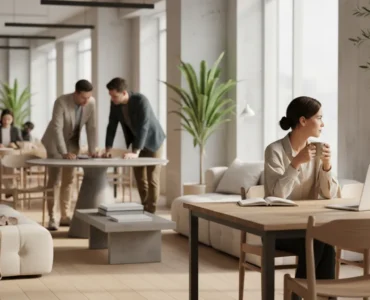
Collaboration is often the lifeblood of innovation, but it can also be the biggest distraction in an open-plan office if not managed correctly. Effective layouts include designated areas for team interaction. These can range from large conference rooms for formal board meetings to casual lounges for spontaneous “water cooler” conversations.
In our spaces, we facilitate these high-quality member-to-member interactions through intentionally designed common areas. These aren’t just transition spaces; they are destinations. When you position a lounge near a kitchen or coffee station, you create a natural hub for connection. This is where the “Business Development” layer of a workspace often takes root—where a founder might meet a future partner over a complimentary coffee or tea. For teams that need to host guests or larger gatherings, our meeting rooms and event spaces are designed to support professional presentations and client-facing events.
Private Spaces for Deep Work and Calls
The biggest criticism of the modern open office is the lack of privacy. To counter this, a successful layout must provide “escape hatches” for focused work. This is where phone booths and private meeting rooms become essential.
For a consultant who spends half their day on sensitive client calls, having immediate access to a private phone booth is a necessity, not a luxury. By integrating these private spaces into the layout, you ensure that the “buzz” of the collaborative zone doesn’t derail the concentration required for complex tasks. At Workbox, our members have 24/7 access to their home-base location, allowing them to utilize these private areas whenever their workflow demands, whether that is at 8:00 AM or 8:00 PM.
Transitional and Social Zones
The areas between desks and meeting rooms are often overlooked, but they play a crucial role in the flow of an office. Clear pathways prevent the space from feeling cramped and allow for better air circulation and light penetration. Social zones, such as the area around the community manager’s desk or the kitchen, should be placed centrally to encourage a sense of community without infringing on the desks where people are trying to work.
The Evolution of Office Design: Moving Beyond the Cubicle
The history of office design has swung from the rigid “action office” cubicles of the late 20th century to the overly sparse “ping-pong table” open offices of the early 2000s. Today, we are in the era of the “Flexible Office.” This approach recognizes that people need variety.
A modern layout should offer a “palette of places.” This might mean a team member spends two hours at a dedicated desk, one hour in a phone booth, and thirty minutes in a lounge area. This variety prevents the physical and mental fatigue that comes from being anchored to a single spot all day.
When we think about our “Member Success” philosophy, we look at how the layout supports a holistic work experience. It isn’t just about the desk; it’s about the ability to move into a wellness room for a moment of reset, or into a high-tech conference room for a quarterly board meeting. The layout should be an enabling layer that removes friction from the workday.
Managing Density and Circulation
One of the most technical aspects of how to design an office space layout is calculating density—how many people can comfortably occupy the space. Overcrowding leads to noise complaints and a sense of “office fatigue,” while a space that is too sparse can feel cold and uninviting.
Strategic Desk Placement
The placement of desks should follow the natural light sources in the room. Natural light is one of the most requested features in any workspace, as it has a direct impact on mood and energy levels. Desks should be oriented to minimize glare on screens while maximizing views of the outdoors where possible.
In a flexible environment, we offer different levels of density through our membership types. A private office or suite provides a dedicated, enclosed space for a team, often including their company logo placement on the door at no additional cost. For individuals or smaller teams, desk memberships and floating memberships provide a professional home base without the overhead of a full suite.
Circulation Paths
Think of your office layout like a small city. There should be “main streets” for heavy foot traffic and “side streets” for quieter areas. Avoid placing desks directly in the middle of a high-traffic route to the kitchen or the printer. Using bookshelves, plants, or low partitions can help define these pathways without making the space feel closed off.
The Operational Backbone of a Great Layout
A beautiful layout is useless if it isn’t supported by a seamless operational backbone. This is where traditional office models often fail founders. When you manage your own traditional office, you are responsible for the “hidden” layout elements: where the server rack goes, how to route the Ethernet cables, where to store the cleaning supplies, and how to manage the mailroom.
At Workbox, we prioritize “Operational Support” to reduce this administrative burden. Our spaces are pre-configured with:
- Fast, Secure Wi-Fi & Ethernet: The layout is optimized for connectivity so there are no “dead zones.”
- Unlimited Printing: Centrally located for easy access without disrupting the workspace.
- Mailing & Packaging Services: Integrated into the operational flow for members (Floating Membership or higher).
- Professional Cleaning Services: Ensuring the layout stays pristine without the team having to manage a janitorial schedule.
By choosing a workspace that bundles these essentials through our membership benefits, a company can focus entirely on its own business development and growth, rather than the logistics of running a facility. This reduces the upfront commitment significantly; instead of negotiating a multi-year lease and spending thousands on infrastructure, you can move into a fully optimized layout with a much shorter commitment, typically a two-month minimum.
Designing for Diverse Workstyles: Relatable Scenarios
To truly understand how to design an office space layout, it helps to look at how different professionals interact with their environment.
Scenario: The High-Growth Tech Startup
Imagine a small tech team that has just secured its first round of funding. They are moving out of a shared apartment and into their first real office. They need a layout that fosters the intense, collaborative “sprint” nature of their work but also provides a professional setting for investor meetings.
For this team, a private office suite at Workbox serves as a dedicated headquarters. They have a central area for their desks where they can code and collaborate, but they also have immediate access to private conference rooms (starting at $60/hr for additional bookings) when it’s time to pitch to a capital partner. Because they are part of a larger community, they also benefit from weekly community-based engagements, allowing them to connect with other innovators who might become their first high-level hires or strategic partners.
Scenario: The Independent Consultant
Now, consider a legal or financial consultant who primarily works solo but needs to project a high degree of professionalism. Their layout needs are less about team density and more about versatility.
For this professional, a Floating Membership provides the perfect balance. On days when they need to do heavy research, they can find a quieter environment in a private space or use a phone booth for client calls. When they have a day of back-to-back meetings, they can book a professional meeting room that reflects the quality of their brand. They don’t have to worry about the “office chores” like brewing coffee or fixing the printer; those operational details are handled, allowing them to remain billable and focused.
The Role of Community in Layout Design
A workspace should not be a silo. One of our core differentiators is “Member Connection.” A great office layout should facilitate these connections naturally. This is why we design our common areas to host purposeful programming and networking events.
When a layout includes an open kitchen and lounge area, it becomes the site for community breakfasts and happy hours. These events are more than just social perks; they are business development opportunities. By bringing together leaders, innovators, and investors in a shared physical environment, the layout itself becomes a catalyst for growth. Our members also gain access to a virtual platform and business-development resources, ensuring the connectivity of the physical layout extends into the digital realm.
Flexibility as a Design Principle
The most important thing to remember about how to design an office space layout is that it should never be static. Business needs change. A team that is all-hands-on-deck today might be partially remote next month.
The traditional office model is notoriously inflexible. If you sign a seven-year lease on a 5,000-square-foot space, you are stuck with that layout regardless of how your company evolves. In contrast, the flexible workspace model allows you to scale your footprint up or down. You might start with a few desk memberships and transition into a private suite as your headcount grows.
This flexibility extends to how you use the space day-to-day. Members at Workbox have 8:30 AM to 5:00 PM access to any of our locations nationwide. This means your “office layout” essentially expands to include professional spaces in multiple cities, providing a consistent experience for your team and a professional presence for your clients wherever you do business. If you just need a short-term option, our day pass provides drop-in access to common areas and amenities for a day.
Essential Infrastructure: The Non-Negotiables
Regardless of the specific layout style you choose, certain infrastructure elements are non-negotiable for a professional environment.
- Acoustics: Sound travels easily in modern buildings. A good layout uses “soft” elements like rugs, plants, and acoustic panels to dampen noise. The inclusion of phone booths is the single best way to manage noise levels in a shared environment.
- Power Access: There is nothing more frustrating than a beautiful lounge area where you can’t plug in your laptop. A functional layout ensures that power outlets are accessible from every seating area.
- Storage: Clutter is the enemy of productivity. Even in a digital age, teams need a place for coats, bags, and supplies. Our private offices and suites include furnished desks and chairs, but also allow for personal storage solutions to keep the workspace organized.
- Technology Integration: Meeting rooms should be “plug and play.” We ensure our conference rooms are equipped with the necessary hardware for seamless video conferencing, reducing the time wasted on “tech setup” before a meeting starts.
Creating a Professional Presence
For many businesses, the office is a key part of their brand identity. When clients or partners visit, the layout should communicate stability and professionalism.
This starts at the front door. Having a dedicated community manager to greet guests during staffed hours (8:30 AM – 5:00 PM, Monday through Friday) provides a level of service that most small businesses couldn’t afford on their own. It creates a “reception” experience without the cost of hiring a full-time receptionist.
Furthermore, having your own company logo on your office door (included for suite members) helps establish your office as a true corporate headquarters. It signals to your team and your clients that you have a permanent, professional home within a prestigious community of other leaders and innovators.
How Workbox Simplifies the Design Process
Designing an office from scratch is a monumental task. It involves architects, contractors, furniture vendors, and IT specialists. For a founder, this is a massive distraction from their actual mission.
At Workbox, we take the guesswork out of how to design an office space layout. Our spaces are designed by experts who understand the nuances of the modern professional’s needs. We combine:
- Aesthetics and Function: Our spaces are designed to be beautiful, but every chair and table is placed with productivity in mind.
- All-Inclusive Amenities: From filtered water and complimentary coffee to draft and bottled beer (where applicable), the “amenity layout” is already solved.
- Safety and Security: Our layouts include secure access points, ensuring that your team and your data are protected 24/7.
- Strategic Networking: We position your office within a network of other innovators, providing access to quarterly mixers and partnership events across the country.
By moving into a Workbox, you aren’t just renting a desk; you are gaining access to a platform built for Member Success. You get the benefits of a custom-designed headquarters with the flexibility of a monthly membership.
Conclusion
Designing an office space layout is a strategic exercise that goes far beyond furniture placement. It requires a deep understanding of your team’s work habits, your company’s growth trajectory, and the psychological impact of the environment. A successful layout balances the need for connection with the requirement for focus, and it supports the operational needs of the business without becoming an administrative burden.
In the modern landscape, the most successful companies are those that prioritize flexibility and community. They recognize that a “Workspace with a Purpose” is a powerful tool for attracting talent, impressing clients, and fostering innovation. By choosing a workspace partner like Workbox, you can bypass the headaches of traditional office design and move straight into an environment that is optimized for your success from day one.
Whether you are a solo consultant looking for a professional home base or a growing enterprise in need of a new corporate headquarters, the right layout is waiting for you. We invite you to explore our diverse range of private offices, suites, and desk memberships designed to help you grow.
Ready to find your next workspace? View our locations and book a tour today to see how our layouts can support your team’s success.
FAQ
What is the most important factor when designing an office layout?
The most important factor is “flow.” A layout should allow for seamless movement between different types of work—such as moving from a collaborative team meeting to a private phone booth for a client call—without creating bottlenecks or distractions for others. It’s about creating a balance between open, social areas and private, focused spaces.
How much space does each employee need in an office layout?
While industry standards vary, a comfortable layout typically allows for enough space that employees don’t feel “elbow-to-elbow.” In a flexible workspace environment, this is managed by providing a variety of work areas. While an individual desk membership provides a dedicated spot, the total “usable” space includes lounges, kitchens, and meeting rooms, which significantly increases the square footage available to each person compared to a cramped traditional office.
How can I make an open office layout less distracting?
The best way to manage distractions in an open layout is through “zoning.” Use phone booths for calls, bookable meeting rooms for group discussions, and ensure that high-traffic areas like the kitchen are separated from the main desk areas. Providing these “escape hatches” for private or loud activities keeps the main workspace more conducive to focus.
Why is a flexible office layout better than a traditional one?
A flexible office layout allows your workspace to grow with your business. Instead of being locked into a rigid, long-term lease for a space you might outgrow or underutilize, a flexible model allows you to adjust your footprint as needed. Furthermore, flexible workspaces like Workbox handle all the operational overhead—such as utilities, cleaning, and tech infrastructure—allowing you to focus entirely on your business development.